
A bonsai is a potted tree admired for its elegance and distinctive appearance. However, before you can fully enjoy its beauty, patience and dedication are essential. Bonsai trees differ from many traditional plants because their development is a slow and gradual process. So, how long does it actually take for a bonsai to grow and reach its ideal form? In this guide, we have brought together the key information you need to understand bonsai growth.
Understanding how a bonsai grows
A bonsai grows in much the same way as a conventional tree. However, to maintain its miniature size and characteristic shape, several techniques need to be used, including pruning, wiring and repotting. Its growth rate depends mainly on the species being cultivated. As a general guideline, a bonsai can take around five to ten years to reach a more mature stage.
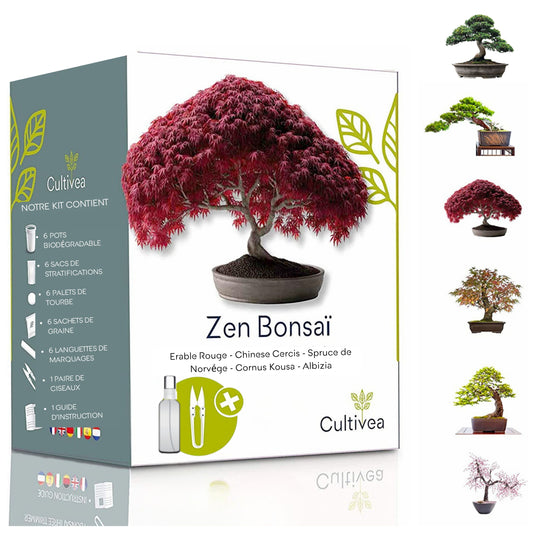
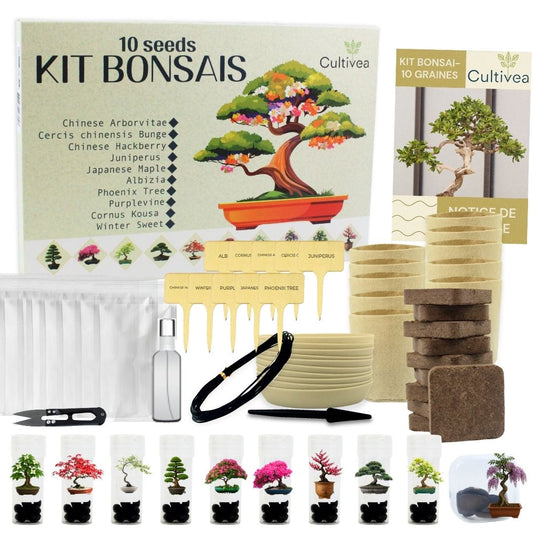
The varieties offered by Cultivea are particularly suitable for beginners and make it possible to observe the different stages of bonsai development step by step. Our Mini Bonsai Kit is an excellent way to discover the art of bonsai and learn more about how these miniature trees grow and how to care for them.
The stages of bonsai development and how long they take
Whatever the bonsai species, the main stages of development are broadly similar, with each stage requiring specific care.
-
Germination and early growth: Germination and the initial development of the bonsai's roots can take around 1 to 2 years. At this stage, the tree's growth is still limited and it does not yet have the characteristic appearance of a bonsai.
-
Trunk development and branching: This stage generally takes around 2 to 5 years. The tree begins to develop a clearer structure. The first pruning can be carried out to guide the shape of the trunk. Repotting is also an important part of caring for the bonsai during its development.
-
Foliage development and shaping: This stage generally takes place around 5 to 10 years after germination and the initial growth phase. The main structure of the bonsai becomes increasingly defined. Regular wiring and pruning help refine the design of the miniature tree, while the foliage becomes denser and enhances its overall appearance.
-
Maintenance and refinement: After approximately 10 years, the bonsai may have reached a much more mature and developed form. At this stage, the miniature tree still requires consistent care. Pruning generally becomes more selective and is used to maintain the tree's balance and refine its shape over time.
Factors that influence bonsai growth time
The amount of time a bonsai needs to develop can vary depending on several factors.
-
The bonsai species: Some varieties, such as the Red Maple or ficus, may develop more quickly than others. Species such as pine or juniper can require more time to achieve a mature appearance.
-
The environment: Light, temperature and humidity all influence bonsai development. Suitable growing conditions can support healthier and more consistent growth.
-
Pruning and shaping techniques: Cutting stems, leaves, roots or branches influences both the growth and structure of the tree. Appropriate care helps guide its development and shape over time.
-
Nutrients and watering: Providing a suitable fertiliser can support healthy root and foliage development. Controlled watering is also important for maintaining the tree's health and avoiding water stress that could slow its development.
Read our complete guide to pruning and shaping a bonsai like an expert to learn how to encourage healthy development and gradually refine the appearance of your miniature tree.
How can you support bonsai growth and optimise its shape?
Although the art of bonsai is closely associated with patience, there are several ways to support healthy development and make the shaping process more effective:
-
Choose a relatively fast-growing species, such as ficus, maple or Chinese Elm.
-
Provide regular care by pruning branches and repotting the bonsai when necessary.
-
Keep the bonsai in suitable growing conditions with enough light and an appropriate level of humidity.
-
Use a suitable fertiliser to support healthy root and leaf development.
-
Use wiring and gradual pruning to begin shaping the tree from its early years.
How long can bonsai trees live?
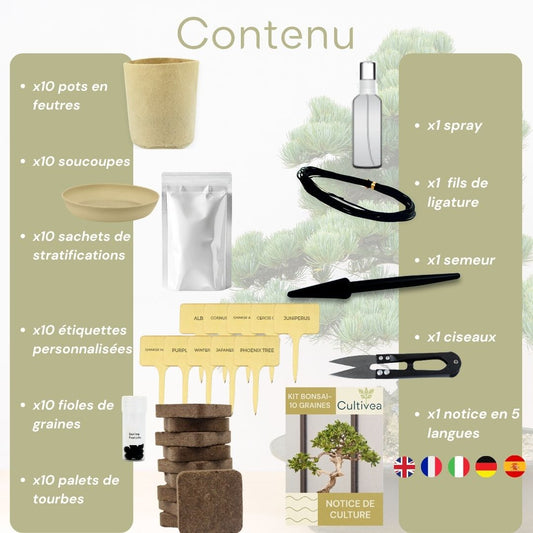
Bonsai trees can be remarkably long-lived. Some species and individual trees can survive for many decades or even centuries when properly cared for. Consistent care and suitable watering play an important role in their long-term development. It is also essential to monitor the moisture level of the growing medium and protect bonsai trees from extreme weather conditions to help maintain their health and resilience. At Cultivea, we offer a Premium Ready-to-Grow Bonsai Kit designed for anyone who wants to discover this centuries-old art. The kit allows you to follow the different stages of bonsai development and learn how to care for your miniature tree. It includes the essential tools and equipment needed to support you throughout the growing process and help you reconnect with nature.