
Bonsai trees are fascinating because they look like mature trees in miniature form. One question often comes up: can you make a bonsai from any tree? A simple “yes” would be too broad. In principle, many woody tree and shrub species can be grown as bonsai from seeds, cuttings or young plants. However, not all species are equally well suited to long-term cultivation as miniature trees.
Can all trees become bonsai?
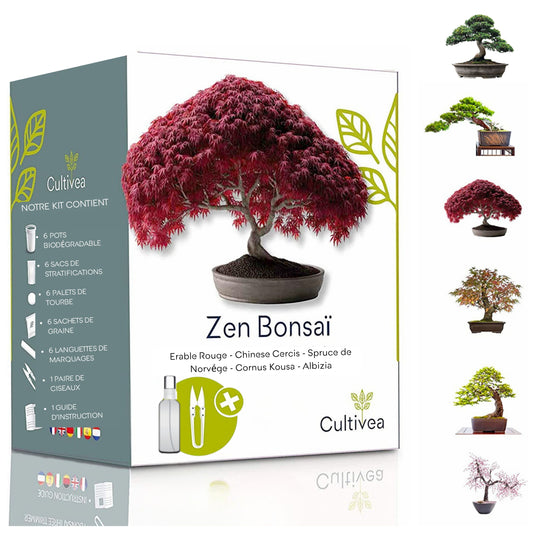
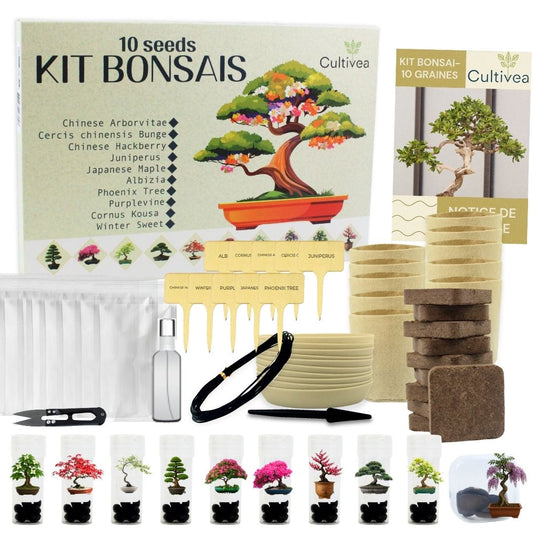
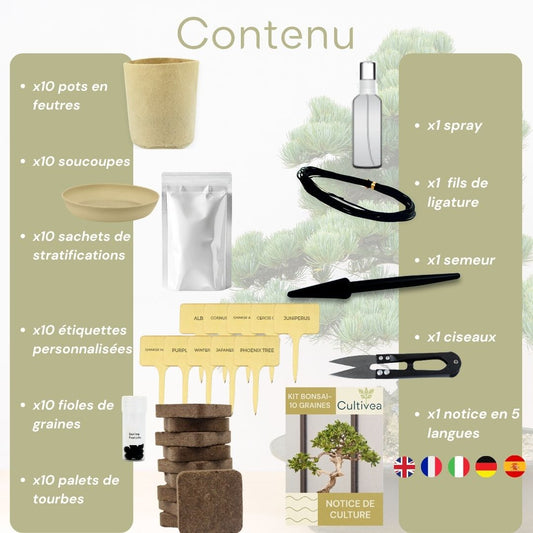
In theory, a very wide range of woody tree and shrub species can be cultivated as bonsai. The key point is that the plant must tolerate regular pruning, root pruning and life in a restricted container. Some species grow particularly vigorously or respond poorly to the techniques commonly used in bonsai cultivation. For beginners, it is therefore usually better to choose species that are naturally well suited to bonsai. You can find easy-to-grow seeds from several tree species in our Premium Ready-to-Grow Bonsai Kit. The kit also includes useful tools for caring for your miniature tree.
Characteristics to consider when choosing a tree for bonsai
A successful bonsai depends on a balanced relationship between its different parts, especially the trunk, branches, leaves and pot. Good bonsai design is therefore based on harmonious proportions. When choosing a suitable tree, several characteristics are worth considering:
-
Small leaves: Trees with naturally small leaves, or species whose leaf size can be reduced through appropriate cultivation and pruning techniques, are generally better suited to bonsai.
-
Dense branching: A tree with plenty of branches and short internodes is usually easier to shape into a balanced miniature tree.
-
A thick, tapered trunk: A trunk that is wider at the base and gradually narrows towards the top gives an impression of strength and maturity.
-
Ability to adapt to miniature cultivation: Species such as maples, pines and Chinese elms are particularly well suited to compact bonsai cultivation. Very vigorous or large-leaved species can be more challenging to maintain in miniature form.
The best tree species for creating a bonsai
Would you like to turn a tree into a bonsai? Cultivea presents some of the main species that are particularly well suited to this practice.
Bonsai species suitable for beginners
These trees are good choices for anyone taking their first steps into the art of bonsai:
-
Ficus retusa: hardy and relatively easy to care for, making it a popular choice for beginners.
-
Chinese elm: grows relatively quickly and responds well to regular pruning.
-
Serissa: valued for its small leaves and delicate flowers. It is often grown as bonsai, although it benefits from suitable growing conditions.
At Cultivea, we also offer a Mini Zen Bonsai Kit, designed for anyone who would like to discover this centuries-old art.
Conifers suitable for bonsai
Conifers are particularly popular with bonsai enthusiasts because of their distinctive appearance and longevity:
-
Pine (Pinus): appreciated for its characterful trunk and evergreen needles.
-
Juniper (Juniperus): particularly well suited to cascade and semi-cascade styles.
-
Spruce (Picea): requires a little more patience but can develop an attractive and distinctive structure.
To better understand how to shape your miniature tree, it is also worth exploring the different bonsai styles and forms.
Popular deciduous trees for bonsai
Many deciduous trees also make highly decorative bonsai:
-
Red maple or Red Maple bonsai: particularly attractive in autumn when its leaves develop striking red tones.
-
Birch (Betula): relatively fast-growing and requires regular, careful pruning and shaping.
-
Hornbeam (Carpinus betulus): highly valued for its elegant bark and fine branching.
Flowering and fruiting bonsai species
If you are looking for a particularly ornamental bonsai, flowering and fruiting species are also worth considering:
-
Japanese quince: produces attractive, colourful flowers.
-
Apple tree (Malus): valued for its beautiful blossom and small decorative fruits.
-
Wisteria: particularly impressive thanks to its hanging flower clusters and well suited to expressive bonsai designs.
How do you turn a tree into a bonsai?
Turning a tree into a bonsai is a gradual process that involves several steps:
-
Select a suitable plant
-
You can start with a bonsai kit containing a young plant.
-
A naturally growing tree can also be collected and developed as a Yamadori bonsai. However, trees should only be collected where this is explicitly permitted and with any necessary authorisation.
-
Prune the roots and foliage
-
Carry out controlled root pruning to gradually adapt the tree to life in a bonsai container.
-
Reduce the branches progressively to build the desired shape.
-
Choose a suitable bonsai pot
-
Use an appropriate bonsai pot, often relatively shallow, that suits the tree's stage of development.
-
Make sure the pot has good drainage so that excess water can escape easily.
-
Apply suitable training techniques
-
Shape the branches through careful pruning. Our complete guide to pruning and shaping a bonsai explains the essential techniques.
-
Wire branches carefully with aluminium or copper wire when necessary to guide their growth direction.
-
For suitable species and healthy trees, techniques such as partial or complete defoliation can sometimes be used to encourage finer branching. However, this method is not suitable for every species and should be used with care.
-
Maintain your bonsai regularly
-
Water according to the tree's needs and check the moisture level of the growing medium regularly.
-
Feed the tree during the growing season with a suitable bonsai fertiliser according to the requirements of the species.
Mistakes to avoid
-
Choosing an unsuitable species: very large leaves or extremely vigorous growth can make bonsai training more difficult.
-
Pruning too severely all at once: excessive pruning can unnecessarily weaken the tree.
-
Neglecting watering: both prolonged dryness and waterlogged soil can damage a bonsai.
-
Using an unsuitable pot: the container should suit the size, development stage and root system of the tree and should provide adequate drainage.
Whatever species you choose, the most important thing is to understand the right training and care techniques while respecting the individual needs of the plant. This gives your miniature tree the best chance of remaining healthy for many years.